By Nouha Bouazizi
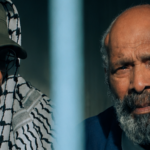
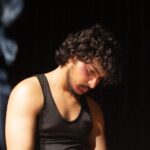
Short movie « Till last breath » directed by Ghassen Jerbi
How do we give a voice to someone who lacks it?
By giving him many voices.
But in doing so, don’t we amplify his silence –
even more, don’t we drown him out?
Nedhir never tells us his own story. Everyone else around him does. We piece it together fragment by fragment: from the girl on the stairs we know he is a widower, from the neighbor at the shop, we discover he works at the museum, from the tourists we deduce he is ignorant, irrelevant.
Our encounters with these characters are shallow; consisting of gossip and unfinished gestures. They discard these fragments of information on the ground. And we pick them up off of it. We try to form the puzzle that is Nedhir’s life.
Hence, these characters are strangers to Nedhir, and by extension to us.
From the start, I said Nedhir has no voice. But he does try to speak: to tourists, to his son, to a hospital worker. Except that they either respond in hollow words or not at all. This portrays him as a stranger to his son, his work, and his community.
His voice is thus lost; his words are fading away just as they are pronounced.
The silence pushes Nedhir to find a voice in the past. He converses with a statue of Hannibal. He tries to reconstruct a painting of an ancient war, with puzzle pieces. Much like us, he is trying to reconstruct the puzzle of his life.But does he provide us with enough pieces ? Here we wonder whether the movie, in trying to represent silence and estrangement, came out silent and estranged itself.